For a UK small business, choosing how often to pay for a productivity suite is not simply a price comparison. Email, documents, shared files and collaboration tools become part of day-to-day operations, so the billing term should support the way the team expects to work.
A longer commitment can suit a settled team with clear requirements and a planned software budget. Monthly billing can be more comfortable when headcount, adoption or storage needs are still moving. The useful question is not which option is universally better, but which one leaves the business with an acceptable balance of cost certainty and room to change.
Annual vs monthly plans: the decision in brief
Start with four practical checks: how stable the team is likely to be, which features each group genuinely needs, how much cash the business is comfortable committing, and what happens if requirements change before renewal.
Annual billing can make the budget easier to plan because the commitment and payment schedule are known in advance. Monthly billing usually creates more frequent decision points, which may help a business that is hiring, testing a new way of working or unsure whether every employee will adopt the same tools.
Do not treat the billing term as a substitute for choosing the right product plan. A low-usage employee may need secure email and a calendar; a project lead may need substantially more file storage or collaboration features. First decide what each role needs, then compare the supplier’s current terms for paying monthly and annually.
For a broader framework, use the productivity-suite selection criteria alongside this decision.
When an annual commitment can make sense
An annual commitment is most likely to fit when the business can describe its next year with reasonable confidence. That does not require perfect forecasts. It means the core team, essential services and main working patterns are unlikely to change so dramatically that the subscription becomes unsuitable.
It can be a sensible operational choice when:
- the business has a stable group of employees who need continuing access to email, documents and shared workspaces;
- the budget owner wants a known software commitment to include in the annual plan;
- the organisation has already established which features and storage levels different roles require; and
- the renewal date can be owned by a named person rather than discovered after the fact.
Plan design matters as much as the term. Zoho Workplace says that businesses can mix different product and storage plans across their workforce, with no limit on the number of users on each chosen plan. Its published range includes Mail Lite, Mail Premium, Workplace Standard and Workplace Professional, with different mail and file-storage allowances and feature sets. That type of structure can help a stable organisation avoid paying for one uniform configuration when its roles have clearly different needs. Zoho Workplace flexible pricing
Before choosing annual billing, record the supplier’s current renewal process, payment timing, seat-change rules, downgrade options and cancellation position. A commitment is easier to manage when those terms are known before purchase rather than when the renewal notice arrives.
See the business-software budget-planning guide for a simple ownership and renewal calendar.
Where annual plans can limit flexibility
A longer term can be less comfortable when the business is still learning what it needs. A new team may hire quickly, consolidate roles, change contractors, open a new location or discover that some employees need more storage and security features than expected. These are operational changes, not necessarily mistakes in the original purchase.
The first risk is paying for a configuration that no longer matches the workforce. The second is treating a plan change as if it were automatically the same as a subscription-term change. They are separate questions. A provider may offer several plan levels or storage options while still applying its own rules to renewals, billing frequency, seats, upgrades and downgrades. Confirm those rules in the current UK checkout flow or with the supplier’s sales team.
Zoho Workplace presents plan and storage mixing as a way to tailor subscriptions to different employee needs, including adding storage without upgrading an entire subscription. That may reduce the need for a single high-spec plan for every user, but it does not remove the need to verify the commercial terms that apply to the chosen billing arrangement. Zoho Workplace flexible pricing
Monthly billing is often worth considering when adoption is unproven, the headcount plan is uncertain, or preserving near-term cash flexibility matters more than locking in a longer cycle. It can also be the safer interim choice when the business has not yet assigned ownership of renewals and supplier administration.
Use the SaaS contract-management guide to keep the term, seat count and renewal responsibilities in one record.
Calculate the real saving before you commit
 Do not rely on an advertised annual discount alone. Build two like-for-like totals using the supplier’s terms that are available to your business at the point of purchase.
List each user group and the product plan it needs. Separate light email users from employees who need office apps, advanced meeting tools, administration controls or larger storage allowances.
Write down the current monthly price and annual-billing price for the same plan, currency, seat count and market. If the supplier does not display a price that can be verified for your UK purchase, mark it as “to confirm” instead of estimating it.
Calculate the comparable annual cost for each option:
monthly route = monthly per-seat charge × seats × 12annual route = annual per-seat charge × seatsAdd costs that are easy to miss: add-on storage, extra services, applicable taxes, implementation work, training, data migration and the cost of changing configuration if the team grows or shrinks.
Compare the totals only after checking whether the supplier’s stated terms make the options genuinely comparable. A lower headline figure may not be the lower operational cost if it includes unused capacity or creates costly change later.
Where plan mixing is available, calculate by group rather than applying one plan to the whole company. Zoho Workplace states that customers can choose an unlimited mix of product and storage plans, and identifies four plan categories—Mail Lite, Mail Premium, Workplace Standard and Workplace Professional—with different storage and feature profiles. That makes role-based modelling more useful than a single average seat price. Zoho Workplace flexible pricing
A simple worksheet might have columns for role, number of seats, required plan, storage add-on, monthly route, annual route, change assumptions and verification date. Keep the supplier page or written quote with the worksheet, because prices, promotions and contract terms can change.
If the two totals are close, the decision may be driven by flexibility rather than a small headline difference. In that case, ask whether the business would be comfortable carrying the annual configuration through a realistic hiring, leaver or storage-change scenario.
Use the software cost calculator for the arithmetic, then run the result through the business-software procurement checklist before approval.
Choose a billing term that matches your operating plan
AI-generated generic editorial illustration — not a retailer product photo and does not depict the reviewed product or service. Give readers a quick visual framework for selecting a billing term that fits their operating plan.
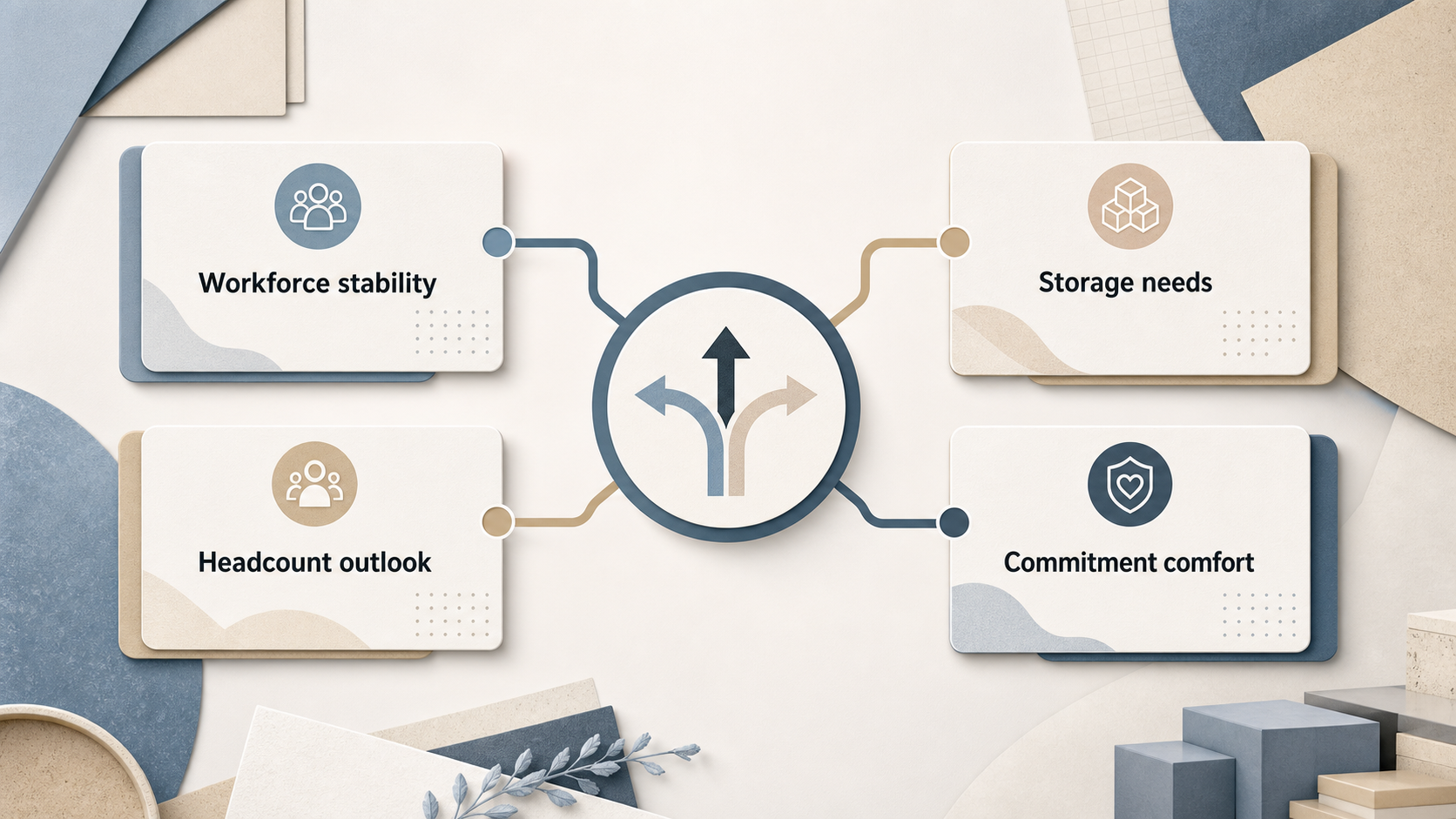 Use the following decision path rather than starting with a preferred payment frequency.
Stable team and established needs. Annual billing may fit if the core seat count is dependable, each role’s requirements are known, the budget is approved and the business has checked its renewal and change options. Revisit the configuration before committing so that light users and higher-need users are not automatically assigned the same plan.
Growing team with a credible forecast. Either term can work. Model the expected additions by role and ask how the supplier handles seat increases, plan changes and storage needs. An annual commitment can still be appropriate for the stable core, provided the team has verified how later changes are treated.
Uncertain, seasonal or newly adopting team. Monthly billing may be the more cautious starting point while the business learns adoption patterns and confirms which roles need which features. Set a review date after the first operating period; flexibility only helps if someone uses it to make an informed decision.
Storage or feature requirements are uneven. Look for a provider structure that allows suitable plan levels or storage options by user group. Zoho Workplace says its flexible-pricing approach supports mixing product and storage plans across employees. Verify the precise plans, storage limits, billing choices and UK commercial terms before ordering. Zoho Workplace flexible pricing
Whichever route is chosen, document five items: the renewal date, the owner of the subscription, the current seat inventory, the approved plan mix, and the process for reviewing upgrades, downgrades and leavers. That turns a one-time buying decision into an operating routine.
The small-business software-buying guide can help turn these checks into a short approval record.
Frequently Asked Questions
Is an annual productivity-suite plan always cheaper than paying monthly?
No. Compare the supplier’s current UK terms for the same plan, seats, storage and billing basis. Even where an annual route has a lower headline subscription total, the better value depends on whether the business will use the committed configuration and on any add-ons or change costs. Confirm the final terms at checkout or with sales.
Can a business mix different plan levels across employees?
It depends on the provider. Zoho Workplace says customers can mix product and storage plans, with no limit on users assigned to their chosen plans. Its listed categories include Mail Lite, Mail Premium, Workplace Standard and Workplace Professional. Check the supplier’s current plan, billing and administration terms for your specific purchase. Zoho Workplace flexible pricing
What should we confirm before an annual subscription renews?
Confirm the renewal date, payment amount, current seat count, plan mix, storage add-ons, notice requirements and the available options for changing or reducing plans. Also make sure one named employee owns the renewal decision and has the latest supplier quote or checkout evidence.
When is monthly billing the safer choice for a small team?
Monthly billing can be the safer choice when headcount is uncertain, the team is testing a new suite, cash flexibility is important or feature needs have not yet settled. Review the arrangement after a defined period rather than letting an early temporary choice become the default indefinitely.
Use the subscription-renewal checklist to capture the final questions before placing or renewing an order.
Sources
Related reading
- Microsoft 365 review for UK small businesses: strengths, limits, costs, and alternatives
- Proton Workspace review for UK small businesses: privacy-first fit and limitations
- Business productivity suite checklist: collaboration, administration, security, and support
- How to compare productivity suite pricing without overlooking renewals, storage, and add-ons
Editorial information: About our editorial team · Read our editorial policy · Read our affiliate disclosure.